At your need · 24 hours · Every day (615) 256‑3608

The Patton Ledger · Chapter 02

Our Story.

Franklin, Tennessee
1882 — Present
Four Generations
Plate · 02·a · Franklin, Tennessee · 1882

A young man's ambition in Franklin.

The Reverend John Thomas Patton was twenty‑three years old in 1882, the son of Will and Lucy Patton. He had, as the family record puts it, "no high‑school education, no money, no collateral and no experience" — nothing except "a dream, ambition, vision and a good family name."

That name was his collateral. When he went to the Williamson County Bank, the banker Mr. Ed Green told him plainly: "I really don't know you; you have no collateral — but because you're Will and Lucy Patton's son, I'll loan you the money." On that loan, and that reputation, Patton Brothers was born.

It was a community institution from its first day — caring with dignity for the Black families of Williamson County at a time when such care was neither guaranteed nor freely offered. The hearse was horse‑drawn. The processions walked. And family after family came. His brothers — Jasper W., Daniel J., and George W. Patton — soon joined the practice, and the Patton name became the name Middle Tennessee entrusted with its dead.

Rev. John Thomas (J.T.) Patton
Founder · Franklin, Tennessee · 1882
Plate · 02·b · The Ledger

One hundred and forty‑four years.

1882 — 2026
Entry · 01
1882Franklin, TN

The Reverend J.T. Patton opens his doors.

At twenty‑three, John Thomas Patton founds a funeral business in his hometown of Franklin, Tennessee. Horse‑drawn hearses. Walking processions. A handwritten ledger. And a promise to care for families as their own.

Entry · 02
1900sThe Brothers

Jasper, Daniel & George join the practice.

Three of J.T.'s brothers enter the business, giving the firm its permanent name. Patton Brothers expands through Williamson County, and their ledger grows by hundreds of families a year.

Entry · 03
1912The Archive

The ledger that lives on.

A surviving Patton Brothers funeral ledger from 1912–1915 is preserved today in the Nashville Public Library's Special Collections — a rare window into Nashville's Black community and the quiet economics of grief. More than a thousand names, a thousand sums, a thousand families cared for.

Entry · 04
1921Nashville

The move to Nashville.

Patton Brothers carries its practice north to Nashville, opening first on 8th and Drexel Street, then at 419 – 8th Avenue South. The firm expands into Dickson, Mount Pleasant, and later into Kentucky and Michigan.

Entry · 05
1952South Street

The move to 1306 South Street.

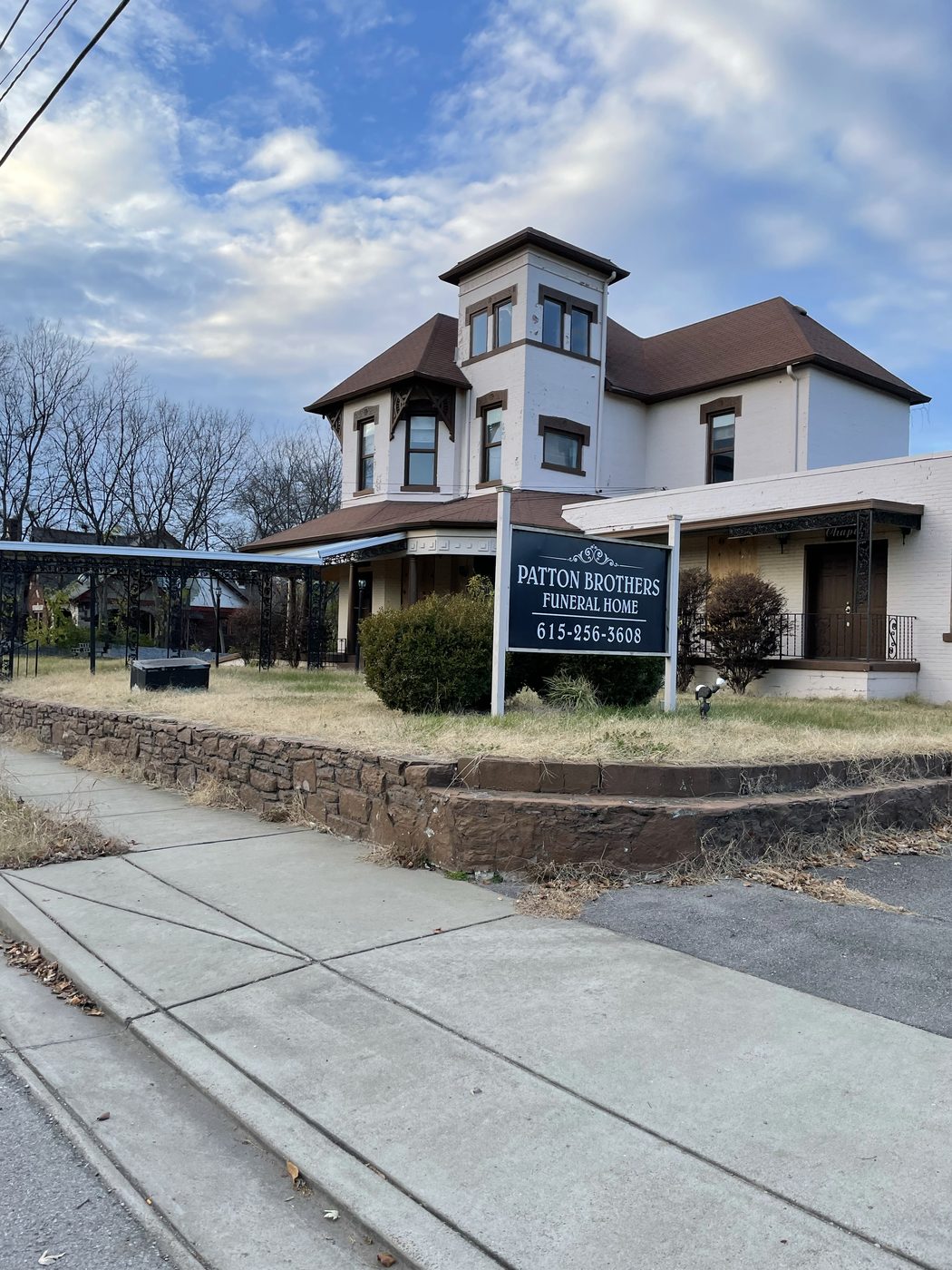
Patton Brothers buys out the Zema Hill Funeral Home and settles into the Victorian building on South Street that still bears its name today. By the mid‑1950s it stands as the largest Black‑owned and operated funeral business in Middle Tennessee — and a community landmark in the Edgehill neighbourhood.

Entry · 06
2021Preservation

Named to the Nashville Nine.

As Edgehill redevelops around it, Historic Nashville, Inc. names the 1306 South Street building to its "Nashville Nine" list of the city's most endangered historic places — recognising it as one of the most significant Black funeral buildings still standing in Nashville.

Entry · 07
TodayNashville

Two houses. One name. Still answering.

Patton Brothers operates two Nashville facilities — the Historic Victorian at 1306 South Street, and the Contemporary New Generation at 2930 Murfreesboro Pike. Licensed directors Tonya Scales‑Haynes, Pastor Derrick L. Jackson, and Jo Anna Kelly lead the family forward into the next generation.

Patton Brothers Funeral Home — the historic Victorian at 1306 South Street, Nashville, today
Plate · 02·d · 1306 South Street, Nashville · The house today

The house on South Street.

Before the Pattons, the Victorian building on South Street belonged to the evangelist Zema Hill. In the 1940s, Hill bought four concrete polar bears — sixty‑five dollars apiece — and set two of them outside the funeral home as a "decorative touch."

When the Pattons took the building, they thought differently. "We didn't think it was proper décor to have two big bears greet grieving people," Ed Patton later told the Nashville Banner, "so when someone came over and asked for them, we gave them away." Those bears scattered across the Edgehill neighbourhood — and, improbably, became one of its enduring symbols.

It is a small story, but a telling one: from the first day, the Pattons measured every detail against a single question — is this the dignity a grieving family deserves? More than seventy years later, the same building still stands, and the same question still guides the work inside it.

“Caring — our highest tradition.” Patton Brothers · 1306 South Street, Nashville
Plate · 02·c · What We Stand On

Four words we have never broken.

Our operating promise
Promise · 01

Dignity

Every person who passes through our doors is cared for with full dignity — regardless of means, regardless of circumstance.

Promise · 02

Community

We were founded to serve Nashville's community when others would not. That mission has not changed in one hundred and forty‑four years.

Promise · 03

Family

We are a family business, and we treat every grieving family as our own — sitting with them, listening, and carrying their wishes faithfully.

Promise · 04

Continuity

Four generations. The same ledger, a new hand. What J.T. Patton opened in 1882, we honour still — and will honour still tomorrow.

Let us carry your family as we have for generations.

Speak with a director — at either house, any hour. We are ready.